Wednesday, 8 November 2017

Bloomfield : a portrait and a puzzle

During his years of success, Robert Bloomfield’s portrait was painted more than half a dozen times. The National Portrait Gallery (the one in London) holds a watercolour portrait by Henry Edridge (1768-1821) and a miniature by Henry Bone (1755-1834). There were other portraits by Pierre Violet (1749-1819) and John Rising (1756-1815), both known only through mezzotint copies.  There is evidence for an oil portrait by John Opie (1761-1807), now lost, and there were probably others. Even the young American, Rembrandt Peale (1778-1860), in London in 1802 and 1803 to exhibit his father’s celebrated mastodon skeleton, sketched Bloomfield for the Peale “portrait factory” in Philadelphia. Engraved portraits, too, formed the frontispieces of several of Bloomfield’s own books but also appeared in periodicals such as The Monthly Mirror and The European Magazine. O’Donoghue’s Catalogue of Engraved British Portraits Preserved in the British Museum (1908-25) lists 13 portraits of Bloomfield. (I have collected 10 of these including a colour-printed version of a portrait of which the British Museum has only a monochrome copy.)

Recently another portrait has come to light, but this time dating from Bloomfield’s years of decline and destitution.


John Dempsey.—“Robert Bloomfield, the poet, 1823”.—Watercolour.—24.2 x 17.8 cm.—Collection : Tasmanian Museum and Art Gallery (AG585), presented by Conrad Docker, 1956.—Inscribed verso, pencil: George Robert Bloomfield Aged 57 1823; on secondary support, ink: Robert Bloomfield (the Poet)—1823.


The artist is John Dempsey (1802/03-1877), an itinerant painter who created portrait miniatures and cut silhouettes across the length and breadth of Great Britain, from Plymouth to Kilmarnock, Liverpool to Scarborough. While Dempsey’s technical skills in areas such as perspective are sometimes lacking, his faces have a haunting, highly-detailed naturalism.

At the end of the 18th century, a substantial new consumer class was emerging. Before the widespread adoption of photography in the 1850s, a small army of artisan painters such as John Dempsey supplied this expanding market with modest, domestic images of themselves. Dempsey’s clientele might not be able to afford to commission a large portrait from a major artist, but could pay for a miniature from a lesser-known one such as himself.

In 1996, the Tasmanian Museum and Art Gallery had to relocate its extensive collection of works on paper. Towards the end of the stock-taking, on a lower shelf in a file marked U for Unknown, a collection of full-length, nineteenth-century watercolour portraits was discovered, of vivid character and astonishing quality. There were fifty-one portraits in the file in watercolour, gouache and pencil, and dating mostly from the 1820s. The portrait of “Tommy Raeburn, the Ayrshire Hermit” bore the inscription “J. Dempsey Pinxt”. John Dempsey’s long exile from British art history was over.

In 2017, “Dempsey’s people: a folio of British street portraits 1824–1844” was displayed for the first time at the National Portrait Gallery in Canberra (Thursday 29 June until Sunday 22 October). It brought together 52 miniatures (51 from the Tasmanian Museum and Art Gallery and 1 from the New Zealand National Library) painted by the itinerant artist John Dempsey over two decades. But these aren’t paintings of aristocrats and gentry. They are portraits of town criers, match-sellers, chimney-sweeps, street-food vendors, crippled soldiers, and other characters populating the urban landscape of Regency-era and early Victorian Britain. Remarkable in their incisive realism and providing rare visual documentation of people otherwise overlooked by history, Dempsey’s portraits present a vivid and distinctive survey of street people in British cities and towns. The paintings of street people were his way of advertising his talents.


Detail.—Dempsey.—“Bloomfield”.

By 1823, Bloomfield’s fame was pretty well over, despite having had a piece published in The Ladies’ Monthly Museum in that year. David Hansen, curator of the exhibition “Dempsey’s People” at the National Portrait Gallery (Canberra) comments
In Dempsey’s picture he is a tragic wreck, his  thin, grizzled hair hanging lankly over his forehead and collar, his bloodshot, rheumy eyes staring vacantly into space. His coat is in rags: the right elbow is holed, a button on the left side hangs by a single thread. A web of yarn dangles off the end of his workbench, tacks and offcuts litter the ground. Even The farmer’s boy himself, the model of rural decorum, the shining example of Georgic virtue, is displaced and beaten by the forces of modern economics. 
Yet, there is resistance here too--a pathetic poet’s dignity. A small volume peeps from behind his right sleeve, there is a manuscript scroll on the floor, and a bottle of ink and a quill stand amongst the shoe lasts, needles and knives (Hansen 2017, 226).
The images in the Dempsey portfolio were in all likelihood painted for demonstration purposes. Dempsey’s practice appears to have been that when he visited a new town, he would paint a full-length watercolour portrait of a local “character”—a blind beggar, a bathing attendant in a seaside town, the Ipswich town crier—and post this up in the inn where he was lodging to advertise his skills. By depicting well-known street people, the most visible “remarkable characters” of each town that he visited, Dempsey could all the more easily convince potential clients of his capacity to capture a “speaking likeness”. So this was Bloomfield’s fate—reduced to the level of a local character in Shefford—a man who was once a famous poet.


[Samuel Williams (?) after John Dempsey].—“George Bloomfield”.—Wood engraving in Hone’s Table Book. Vol. II, p. 815.

Dempsey’s watercolour seems at one point to have found its way into the hands of William Hone who used it to illustrate (apparently erroneously) a Table Book article on Bloomfield’s brother George. Dempsey’s pencil inscription :
George Robert Bloomfield Aged 57 1823
is ambiguous, though correct as to Robert’s age. (Robert was born in 1766; George in 1758. Curiously, another brother, baptised “George Robert Blomfield [sic]” at Honington, 20 Jun 1757, presumably died in infancy.) What worries me is that the other portraits include “Ann ‘Old Nanny’ Chapman, Bury St Edmunds” and George was resident in Bury St Edmunds while Robert lived in Shefford. Did Dempsey ply his trade even in a very small place like Shefford? But if it is George, why is he shown in a state of destitution like his brother?

Sources and Further Reading

David Hansen.—“Dead Poet’s Society”.—Siglo (University of Tasmania).—No 12 (2000), 21-28.
Not seen.

David Hansen.—“‘Remarkable Characters’: John Dempsey and the representation of the urban poor in Regency Britain”.—The British Art Journal.—Vol.11 no1 (1 January 2010), 75-88.

David Hansen.—Dempsey’s People : a Folio of British Street Portraits 1824–1844.—Canberra : National Portrait Gallery, 2017.
A scholarly publication accompanying the exhibition at the National Portrait Gallery, Canberra, Australia.

William Hone.—The Table Book. Vol. II.—London : Hunt & Clarke, 1827.

Freeman Marius O’Donoghue.—Catalogue of engraved British portraits preserved in the ... British Museum.—6 vols.—London : British Museum, 1908-25.
Bloomfield’s portraits are listed in vol.1, pages 204-05.

Friday, 30 December 2016

Three tunes

I recently purchased from BoundlessBookstore (Wallingford, Oxfordshire):
DAVIDSON'S | UNIVERSAL MELODIST, | CONSISTING OF | THE MUSIC AND WORDS | OF | POPULAR, STANDARD, AND ORIGINAL SONGS, &c. | ARRANGED SO AS TO BE EQUALLY ADAPTED FOR: | THE SIGHT-SINGER, | THE PERFORMANCE ON THE FLUTE, CORNOPEAN, ACCORDION, | VIOLIN, OR OTHER TREBLE INSTRUMENT. | VOL. II. | LONDON: | G. H. DAVIDSON, 19, PETER'S HILL, DOCTORS' COMMONS. | MDCCCLIV.
[16], 436 p.;
Bookseller's description: "General wear to boards with corners bumped. Hinges are a bit cracked with webbing visible. Content mainly clean with some foxing. Age toned pages throughout with some spotting to page ends."
<APKD; vol. 2 only, of perhaps 2 volumes published. The publishing history is complicated and unclear.>

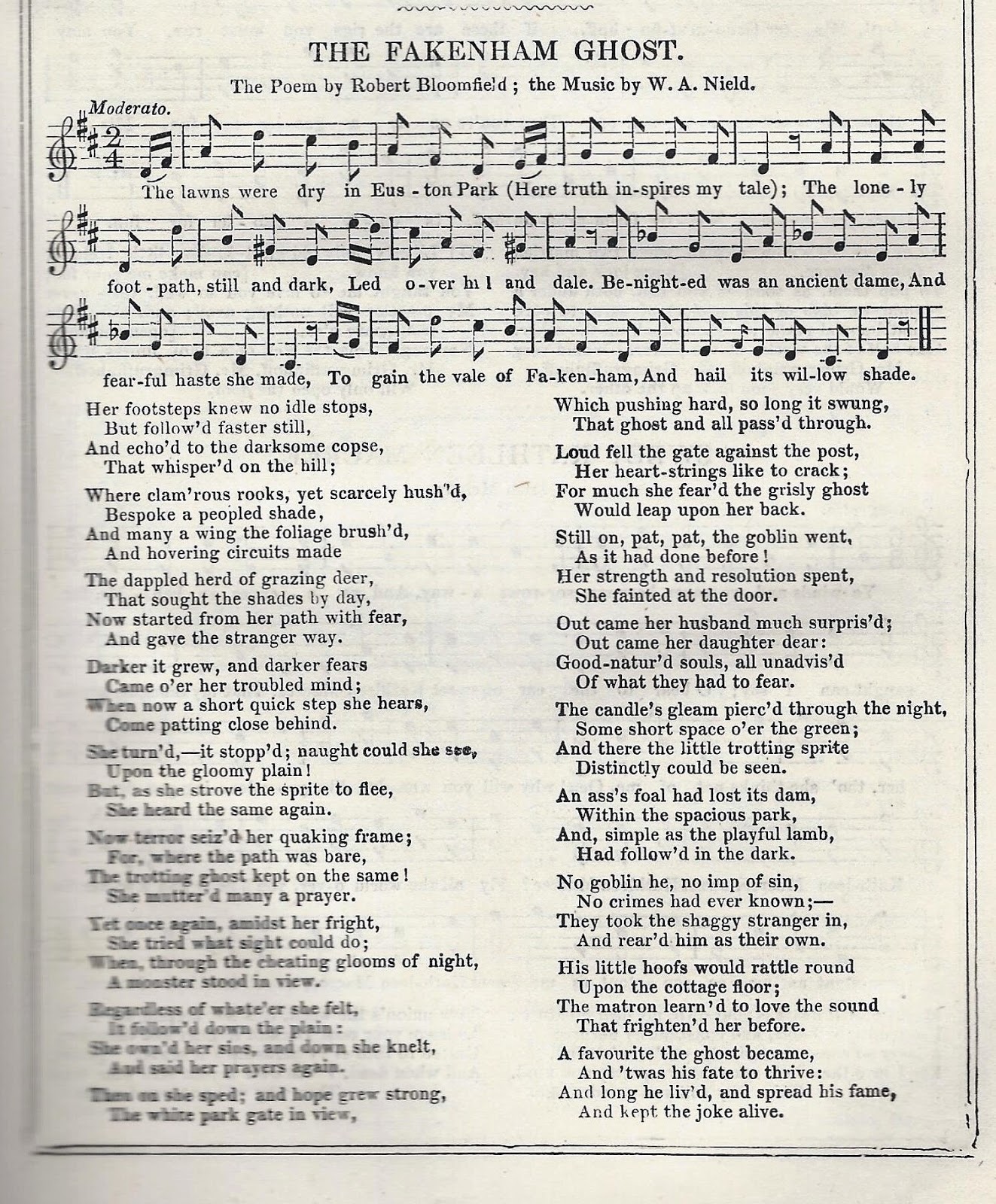
Davidson's Universal Melodist is a later rival to The Universal Songster. But this time developments in printing music from moveable type mean that melody lines can be provided for all the songs included.


The three Bloomfield songs are in Volume II, as follows:

page 89: "The Fakenham Ghost" (music by W. A. Neild)
A setting of "The Fakenham ghost" by William Ashton Nield was published in 1834. This is presumably one of the "original songs" of the title page.

page 249, "Old Ringwood" (music by William Hawes)
I cannot trace any earlier publication, unless this is the setting previously attributed to Isaac Bloomfield.

page 401, "The Woodland Hallo" (music by G. Langham)
I cannot trace any earlier publication. There is an earlier setting (1807) by Nina d'Aubigny.


The Fakenham Ghost


Old Ringwood


The Woodland Hallo


I should acknowledge here that I would never have found these songs without the indexes created by the Vaughan Williams Memorial Library at Cecil Sharp House (http://www.vwml.org/).

Tuesday, 20 December 2016

The snob

SNOB. A nick name for a shoemaker.
(Grose)

Trade card of Bloomfield, Boot & shoe maker, c. 1790:


<Bodleian Library. John Johnson Collection; British Museum. Prints & Drawings, Heal 18.8>

There is some doubt whether this trade card is Robert Bloomfield's or that of his brother George.

1781
By the time Bloomfield was thirteen or fourteen, it was apparent that he was not cut out for the rigours of farm labour. Bloomfield’s mother was advised to find him a situation more suited to his physical capabilities. Her eldest sons, George and Nathaniel, then living in London, offered to take their younger brother into their charge. George, a shoemaker, would take in Robert and teach him the trade, while Nathaniel, a tailor, would provide him with clothing. Accordingly, on 29 June 1781, Bloomfield and his mother completed the stagecoach trip to London, where he was left in his brothers’ keeping. Bloomfield lived with his brother George and four other cobblers in a small, low-rent garret (which also doubled as their workshop) at 7 Pitcher’s Court, Bell Alley, Coleman Street.

The house in Pitcher’s Court, Bell Alley. Bloomfield’s workshop in garrett:


A row of three terraced houses, one said to be the residence of Robert Bloomfield; clothes hanging from a washing line in foreground, two women stand to the left, two boys playing marbles to the right; illustration to the Gentleman’s Magazine.
Etching and engraving, lettered with title below image, followed by “Once the Residence of Robert Bloomfield”, and at top right “Gent. Mag. Dec. 1823 Pl II p.497”.
Height: 171 millimetres. Width: 119 millimetres
<APKD>


1783
About 1783, Robert and George decamped and took up residence at Blue Hart Court, Bell Alley.

1784
In 1784, fearing prosecution by the Committee of the Lawful Crafts for illegally cobbling without having been officially apprenticed, Bloomfield returns to Suffolk. Despite ongoing legal difficulties Bloomfield returned to London after a two-month retreat and managed to finagle a quasi-legal standing as a cobbler by paying 5s. to John Dudbridge, who acted as his pro forma journey-master.

1786
Bloomfield sets up on his own as a shoemaker. His brother George leaves London.

It was also about this time that the earliest evidence that Bloomfield was composing poetry surfaces. Poems that he had apparently composed in his mind while engaged in cobbling and later copied down were dispatched to the London Magazine for publication in the “Poet’s corner”, but his earliest published poem, “A Village Girl”, appeared in another periodical, 24 May 1786.

1790
On 12 December 1790 Bloomfield married Mary-Anne Church, the daughter of a shipbuilder from Woolwich. In the following year the Bloomfields took up residence at 14 Bell Alley, Coleman Street, where the growing family lived and struggled to make ends meet for the next seven years.

1796
May: Bloomfield began composing The Farmer’s Boy.

1798
His brother George in a biography prefacing the Poems 1809 says that in 1798 “Robert is a ladies shoemaker & works for Mr Davies of Lombard Street”.

His last years were spent as a shoemaker at Shefford-cum-Campton, Bedfordshire where he died in 1823.


The shoemaker, from L’encyclopédie: "Cordonnier et cordonnier-bottier," Planche 1ére.

Legend

La vignette ou le haut de la Planche représente la boutique d'un cordonnier.

Fig. 1. Cordonnier qui prend mesure.
2. Ouvrier qui cherche la forme qui convient.
3. Ouvrier qui coud une semelle
4. Ouvrier qui enforme une botte.
5, 6. Deux compagnons.
7. Un savetier sous son échoppe.
a, b, c, rangs de différentes formes.
d, formes de bottes.
e, e, bottes toutes faites.
f, mesures.
g, patron d'empeigne.
h, table chargée de différentes outils.

Bas de la Planche.

Fig. 1. Pince.
2. Tenaille.
3. Chausse - pié anglois.
4. Range - trépointe de derriere.
5. Bésaiguë ou buis.
6, 6. Tranchets.
7. Botte renvoyée à la fig. 48 de la seconde Planche.
8. n. 1. Astic de buis.
8. n. 2. Couteau à pié.
9. Astic d'os.
10. Clou à trois têtes.
11. Clou à deux têtes.
12. Clou à monter.
13. Clou d'épingle.
14. Compas ou mesure.
15. Carrelet.
16. Marteau.
17. Claques d'homme.
18. Claques de femmes.
19. Range - couture anglois.
20. Tranchet à ficher.
21. Etoile.
22, 23, 24, 25, 26, 27, A, B, C, D, E, F, alenes à l'angloise.
28. n. 1. Forme à monter.
28. n. 2. Forme brisée.
28. n. 3. Autre forme brisée.

[Translation
(A work in progress: corrections and suggestions for improvement gratefully accepted.)

The vignette or upper part of the plate represents a shoemaker's shop.

Fig. 1. Shoemaker who takes measure.
2. Worker looking for the right shape.
3. Worker who sews a sole
4. Worker who wraps a boot.
5, 6. Two companions.
7. A cobbler under his stall.
A, b, c, rows of different shapes.
D, forms of boots.
E, e, ready made boots.
F, measures.
G, uppers pattern.
H, table loaded with different tools.


Lower part of the plate.

Fig. 1. Pliers
2. Pincers
3. Lasting pliers

4. Rear thrust.
5. Bésaiguë or boxwood.
6, 6. Paring knives

7. Boot as shown in Fig. 48 of Plate 2.
8. n. 1. Boxwood burnisher
8. n. 2. Half-moon knife.
9. Bone burnisher
10. Nail with three heads.
11. Nail with two heads.
12. Nail to be mounted.
13. Pin nail.
14. Shoemaker's rule or caliper measure
15. Square section needle
16. Hammer.
17. Vamp (men)
18. Vamp (women)
19. English stitching.
20. Cutting edge.
21. Etoile.
22, 23, 24, 25, 26, 27, A, B, C, D, E, F, English awls
28. n. 1. Last to be assembled.
28. n. 2. A broken
last.
28. n. 3. Another broken last.
]


Epitaph

Bloomfield left an epitaph for himself, which was not used:
First made a Farmer’s Boy, and then a snob,
A poet he became, and here lies Bob.
                                                     April 1823.
<BL Add MS 30809 f.11, quoted in Selected Poems, page 131.>


Sources and further reading

Robert Bloomfield.—Selected Poems; edited by John Goodridge and John Lucas.—Nottingham: Trent Editions, 1998.

Denis Diderot & Jean le Rond d'Alembert.—L’Encyclopédie ou Dictionnaire raisonné des sciences, des arts et des métiers.—Planches.—3e vol.—Paris, 1763.

Le grand dictionnaire terminologique
http://gdt.oqlf.gouv.qc.ca/

Francis Grose.—A classical dictionary of the vulgar tongue.—3rd ed., corrected & enlarged.—London: printed for Hooper & Co., 1796.

David Kaloustian, “Bloomfield, Robert (1766–1823)”, Oxford Dictionary of National Biography, Oxford University Press, 2004 [http://www.oxforddnb.com/view/article/2676]

William Edward Winks.—Lives of illustrious shoemakers.—New York: Funk & Wagnalls, 1882.

Tuesday, 13 December 2016

The Universal Songster

Wood-engraved half-title

Steel-engraved frontispiece to the first volume of The Universal Songster. Published by John Fairburn, Broadway Ludgate Hill. June 11th 1825. Lettered with publication line and artist’s name “Designed & Etched on Steel for the Universal Songster; By George Cruikshank”. The centre of the design shows two seated men (one of whom resembles a Toby Jug caricature) smoking pipes within a decorative foliate frame. The rest of the design depicts ten other characters, including a soldier and a Scotsman, amidst large decorative swirls. Height: 30.2 cm, width: 21.5 cm.


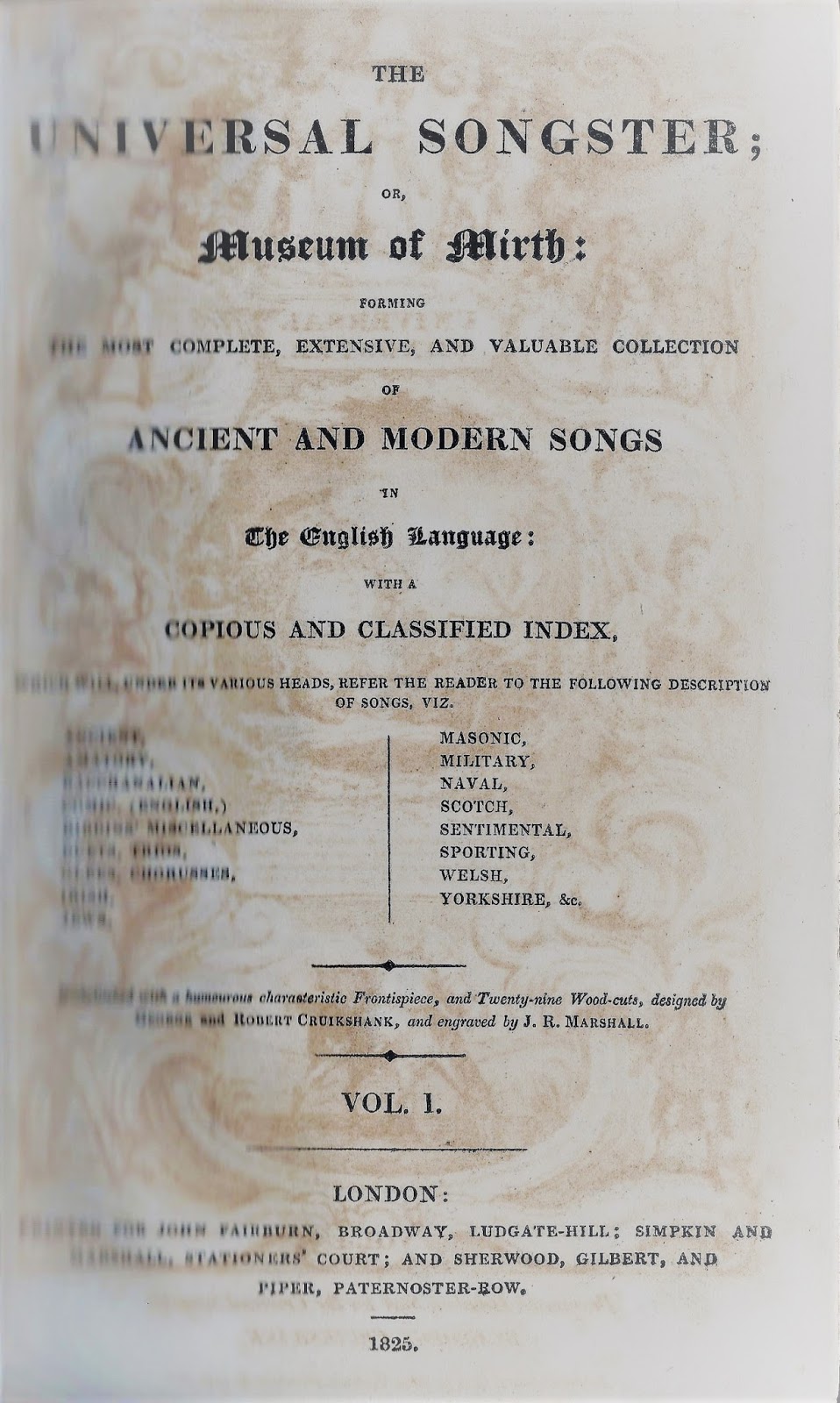
At the beginning of this year I acquired a copy of The Universal Songster from the bookseller Stephen Foster, Fosters’ Bookshop, 183 Chiswick High Road, London W4.
The Universal songster, or, Museum of mirth : forming the most complete, extensive, and valuable collection of ancient and modern songs in the English language : with a copious and classified index which will, under its various heads, refer the reader to the following descriptions of songs—viz. ancient, amatory, bacchanalian, comic (English), Dibdins’ miscellaneous, duets, trios, glees, chorusses, Irish, Jews, Masonic, military, naval, Scotch, sentimental, sporting, Welsh, Yorkshire, etc.—3 vols.—London: John Fairburn, 1825.
The volumes include three etched frontispieces by Cruikshank and 84 wood-engravings, of which 24 are after George Cruikshank, and 57 after his brother Robert. My three volumes have been recently rebound by Maltby’s of Oxford in quarter brown morocco, cloth boards, with gilt lettering. I think it would be almost impossible to find clean copies in the original publisher’s cloth—these books were read and reread. The books contain the texts only of popular “songs of the people” and have, as their title-pages reveal, an idiosyncratic classification system for the songs included. There are six times as many Irish songs as Jewish, and four times as many Scotch as Jewish, and twice as many Jewish as Welsh. As one might expect, the Irish and Jewish songs are filled with coarse ethnic stereotypes; the Scotch and Welsh are not. The songs by Bloomfield included are variously amatory, sentimental, and Scotch. The Universal Songster was reprinted several times throughout the nineteenth century.


Between the 1790s and the 1850s a vast output of chapbooks and songsters was issued under the imprint of the London printer-publisher John Fairburn, one of a dynasty of Fairburns, many of them named John. The family bookshop was initially situated at 146 Minories, close to Tower Hill, but in 1812, John Fairburn senior opened additional premises on the other side of the City in a court off Ludgate. The area was peppered with booksellers spreading west between Paternoster Row and Fleet Street. Fairburn notably employed members of the Cruikshank family of artists as illustrators and caricaturists. Thackeray, in an essay on George Cruikshank, remembered
… walks through Fleet Street, to vanish abruptly down Fairburn’s passage, and there make one at his ‘charming gratis’ exhibition. There used to be a crowd round the window in those days, of grinning good-natured mechanics, who spelt the songs, and spoke then out for the benefit of the company, and who received the points of humour with a general sympathizing roar. (6)
One is tempted to imagine Bloomfield in his way to or from the West End making a detour past Fairburn’s window.


A songster is an anthology of secular song lyrics, popular, traditional, or topical, and typically designed to fit into the pocket. Some later songsters carried melody lines but most songsters are text only. The use of musical notation was limited by the page size and the fact that it had to be engraved rather than set from moveable type. Fairburn Senr’s Laughable Song Book for 1812 has 33 pages, words only, including Bloomfield’s “Love’s Holiday”. So the Universal Songster’s substantial volumes are exceptional. According to Fairburn, the three volumes form: “... the most complete, extensive and valuable collection of ancient and modern songs in the English language ... ”. The public wanted the words to the most popular songs and it was only natural that these would end up in a printed form. There really wasn’t a popular music industry as such at this time—no enforceable copyright ownership in songs and no one could prevent the printing of a song in a newspaper or book. Bloomfield would have received no payment for the pirating of his poems in songsters.

In some ways songsters follow on from the broadside ballad sheets, which were the main printed carrier of songs in the eighteenth century. But in terms of both printed format and means of distribution they relate to the chapbook, still going strong in the early nineteenth century, and its sub-genre, the “garland”.

Chapbooks were small, inexpensive eight-page booklets were often illustrated with woodcuts and printed on coarse paper. They were distributed by traveling “chapmen” who sold the books at markets and door-to-door in rural areas. Chapbooks (called garlands if they included songs) were a popular form of entertainment in the 18th and early 19th centuries and the principal way that ordinary people encountered songs and poetry. Chapbooks and garlands would have provided the young Robert Bloomfield with reading matter and a first introduction to poetry.

Costing a penny for eight small pages (the first given over to a title-page adorned with a crudely-cut and often irrelevant woodcut), a garland would contain the words—but not the music—of perhaps half-a-dozen songs, covering a wide variety of subjects and appealing to a number of levels of taste; a sentimental love lyric in eighteenth-century cliché, a humorous poem describing an Irishman’s adventures in London, a poem in praise of the Battle of the Nile, a sailor’s lament at his absence from home, and so forth. Towards the end of the eighteenth century and the beginning of the nineteenth an enormous number of song-collections designed for the cheapest market were published, the eight-page garland growing into the slightly more extensive songster.

These garlands and songsters throw an interesting light on the popular taste of the time. They were aimed at both genteel and vulgar audiences, and appeared in many thousands of printings between the mid-eighteenth century and the end of the nineteenth with occasional appearances even in the twentieth century. Here’s a song from the Universal Songster that catches the flavour of the period and mentions several extremely popular songs.
The Ballad Seller
Here are catches, songs and glees,
Some are twenty for a penny,
You shall have whatever you please,
Take your choice for here are many,
Hear is ‘Nan of Glo’ster-Green’,
Here’s ‘Lily Of The Valley’,
Here is ‘Kate of Aberdeen’,
Here is ‘Sally In Our Alley’.
Here is ‘Mary’s Dream’ ‘Poor Jack’,
Here’s ‘The Tinker and The Tailor’,
Here’s ‘Bow Wow’ and ‘Paddy Whack’,
‘Tally-Ho’ ‘The Hardy Sailor’,
Here’s ‘Dick Dook’ ‘The Heart Blade’,
‘Captain Wattle’ and ‘The Grinder’,
And I’ve got ‘The Country Maid’,
Confound me though, if I can find her.
Drinking songs, too here abound,
‘Toby Philpot’ ‘Fill The Glasses’
And, ‘Here’s A Health To All Good Lasses’,
Here’s ‘Come, Let Me Dance & Sing’,
And, What’s better far than any finer,
Here’s ‘God Save Great George Our King’
‘Hearts of Oak’ and ‘Rule Britannia’.

The Universal Songster contains ten poems by Bloomfield:


Vol. I.
page 65: THE WOODLAND HALLO! (Bloomfield.)
page 89: WELCOME SILENCE, WELCOME PEACE. (R. Bloomfield.)
page 174: ROSAMOND’S SONG OF HOPE. (Bloomfield.)

Vol. II.
page 28: HAIL, MAY! LOVELY MAY. (R. Bloomfield.)
page 106: ROSY HANNAH IS MY OWN.  (R. Bloomfield.)
page 329: OLD WINTER COMES ON WITH A FROWN. (Bloomfield.)

Vol. III.
page 24: HERE FIRST I MET THE LOVELY MAID (R. Bloomfield.)
page 88: THE PLOUGHMAN’S COURTSHIP (R. Bloomfield.)
page 218: LOVE’S HOLIDAY (R. Bloomfield.)
page 295: HOME IS SO SWEET, AND MY MOGGY’S SO KIND. (Bloomfield.)

The implication must be that all ten poems are well-known songs, and readers of the Universal Songster only need a reminder of the words.

The songs in detail:

THE WOODLAND HALLO!
Category: Amatory.
Composer: Nina d’Aubigny von Engelbrunner (London: Vollweiler, 1806).
On 2 January 1807 the following advertisement was printed on the first page of The Morning Post:
NEW MUSIC, by Miss Nina d’Aubigny Von Engelbrunner, Author of The Essay on Harmony, Letters on the Art of Singing, &c.—This Day is published, in a style particularly elegant and new, Bloomfield’s Woodland Hallo, composed by Miss Nina d’Aubigny Von Engelbrunner, price 1s. Also, a Collection of Songs with English and German Words, by the same Composer. ...  Printed on stone and sold for G. J. Vollweiler, at his Poliautographic Press, No. 9, Buckingham-place, Fitzroy-square …
WELCOME SILENCE WELCOME PEACE
Category: Sentimental.
No composer known.
First published in Wild Flowers (1806) as “Love of the Country”.

ROSAMOND’S SONG OF HOPE
Category: Sentimental.
Composed by Isaac Bloomfield.
First published in May Day with the Muses (1822), page 67.

HAIL MAY! LOVELY MAY
Category: Amatory.
No composer known.
First line: Hail, May! lovely May! how replenish’d my pails!
First published in the Preface to The Farmer’s Boy (1801), page xi, as “The Milk-maid on the first of May”.

ROSY HANNAH IS MY OWN
Category: Amatory.
Settings by both Isaac Bloomfield and James Hook.
First published in Rural tales, ballads, and songs (1802), page 96, as “Rosy Hannah”.

OLD WINTER COMES ON WITH A FROWN
Category: Sentimental.
Setting composed by James Hook.
First line: Dear boy, throw that icicle down,
First published in Rural tales, ballads, and songs (1802), page 104, as “Winter Song”.

HERE FIRST I MET THE LOVELY MAID
Category: Amatory.
No composer known.
First line: Here first I met the lovely maid.
“Air” from Hazelwood-Hall (1823).
As evidence of its continued popularity, later published in The Crotchet; or the Songster and Toast-master's companion: consisting of several thousand favourite songs & popular toasts containing all that is requisite to enable any one to take a part in social and convivial meetings (London: published for the booksellers, 1854), page 178.

THE PLOUGHMAN’S COURTSHIP
Category: Amatory.
No composer known.
First line: Down Abner sate, with glowing heart,
I found the following in Tammas Bodkin: or the humours of a Scottish tailor, a collection of humorous essays in Scots vernacular.
It bein’ Andro’s prerogative to fix upon the individual wha was to sing the neist sang, he pitched upon Miss Swingletree, whase musical reputation was scarcely inferior to that o’ her respected faither. Hoosondever, she beggit to be excused on the grund that she had a sair throat, an’ was as hearse as a crowpie, but she wad ask Mr Hoggie to ack as her substitute, an’ wad feel particularly flattered if he wad favour the company by singin’ “The Ploughman’s courtship,” whilk he furthwith proceeded to do, the haill assembly joinin’ in the chorus, snappin’ their fingers an’ stampin’ on the floor wi’ their tackety shoon like very mad. (362)
Could this be Bloomfield’s poem, now absorbed into folk-song? There is another song of the same title (first line: “When first a-courting I did go”), printed in a Scottish chapbook, which might be considered a more likely candidate. But the chapbook (and the song) is known only in a single copy and no tune has so far been traced. I would like to think that Bloomfield has another shadowy existence as a Scottish poet.

LOVE’S HOLIDAY
Category: Amatory.
Setting composed by James Hook.
First line: Thy Fav’rite bird is soaring still,
Earlier issued by Fairburn in Fairburn Senr’s Laughable Song Book for 1812. With note “Written by Robert Bloomfield, composed by Mr. Hook, and sung by Master Hopkins, with universal applause; at Vauxhall Gardens. Season 1811.”

HOME IS SO SWEET AND MY MOGGY’S SO KIND
Category: Scotch.
Settings by both Isaac Bloomfield and by Robert himself, but presently untraced.
Extract from Bloomfield’s “Song for a Highland Drover returning from England”.
Beginning with the third verse: O Tweed! gentle Tweed, as I pass your green vales.
Verse ends: For home is so sweet, and my Maggy so kind.
First published in Rural tales, ballads, and songs (1802), page 97. Why “Maggy” should be changed to “Moggy” just baffles me.


Sources and further reading

John Fairburn.—Fairburn Senr’s Laughable Song Book for 1812.—London: John Fairburn, 1811.

Michael Kassler, “Vollweiler’s Introduction of Music Lithography to England”, chapter 9 of Michael Kassler, ed., The music trade in Georgian England.—Farnham: Ashgate, 2011.

The Ploughman’s courtship. To which are added, Johnny Coup’s defeat, and The Distressed lover.—Falkirk: T. Johnston, printer, [181-?].
An apparently unique surviving copy in Glasgow University Special Collections.

Tammas Bodkin: or the humours of a Scottish tailor.—Edinburgh: John Menzies, 1864.
A collection of humorous essays in broad Scots, published anonymously, though by William Duncan Latto.

William Makepeace Thackeray.—Essay on the genius of George Cruikshank. With numerous illustrations of his works.—London: Henry Hooper, 1840.
From the Westminster Review, No. LXVI.

Wednesday, 2 July 2014

Ligoran Cosh

Bloomfield's "The Man in the Moon" from The Remains of Robert Bloomfield (1824) is noted as set to the "Irish" tune of Ligoran Cosh.

The tune, here called "Ligrum cus", appears in Volume V of Aird's Selection of Scotch, English, Irish and Foreign Airs. The title, apparently corrupt Irish Gaelic, may be translated as "Let go my foot" and is taken to refer to excessive rents. However, earlier versions of the tune are given the Jacobite title of "Over the Water to Charlie" and appear in Bremner's Reels and Country Dances, 1759, and Johnson's Scots Musical Museum, 1788. Later reworkings may be found in James Hogg's Jacobite Relics. 2nd series, 1821, and in Allan Cunningham's Songs of Scotland, Vol. 3, 1825. Late in its history the tune was given an Irish name, "Ligrum Cus", or "Lacrum Cush", and used for drinking-songs such Ye lads of true spirit lay courtship to claret and I love to see bottles a'rolling. Where Bloomfield found the tune with the title he uses remains a mystery.


SONG.
TUNE. LIGORAN COSH.  
1
The man in the moon look'd down one night,
   Where a lad and his lass were walking;
Thinks he, there must be very huge delight
   In this kissing and nonsense-talking:
And so there must ('tis a well known case),
   For it lasts both late and early.
So they talk'd him down, till he cover'd his face,
   They tired his patience fairly.
2
Then up rose the sun in his morning beams,
   And push'd back his nightcap to greet them;
Says he, "As you boast of your darts and flames,
   My darts and my flames shall meet them."
He scorch'd them both through the live-longday,
   But they never once seem'd to mind him,
But laugh'd outright, as he skulk'd away,
   And left a dark world behind him.
3
Then the man in the moon look'd down in a pet,
   And said, "I believe I can cure you;
Though my brother has fail'd, I may conquer yet
   If not, I must try to endure you.
Go home," he cried, "and attend to my rules,
   And banish all thoughts of sorrow;
Then jump into bed, you couple of fools,
   And you'll both be wiser to-morrow."

And here it is, sung by my friend Stuart


Source

James Aird.A selection of Scotch, English, Irish and foreign airs, adapted for the fife, violin, or German flute.Vol. V.Glasgow : J McFadyen, 1801.

Friday, 7 February 2014

A Fig for the Heralds: Bloomfield's bookplate

In 1812, Bloomfield devised for himself a spoof heraldic bookplate with the motto, “Friends in Need and a Fig for the Heralds”. It occurs in two versions, dated 1812 & 1813, both engraved by W Jackson of Gutter Lane, Cheapside. Angus Whitehead suggests that an encounter with the pompous Lord Ongley may provide a context, or perhaps even a catalyst, for Bloomfield’s mock-heraldic bookplate. Bruce Graver has suggested the engraving reflects Bloomfield during his residence at Shefford as “a little feisty, subversive, more than a little jaded, still clinging to ‘the honest pride of haveing proved […] that a poor man may still possess qualities which [the learned and wealthy] are forced to admire’” (66). But Bloomfield’s design also parodies closely & aggressively the coats of arms of aristocratic families such as Lord Ongley’s.

1812
Shield, crest, & motto, with elaborate scroll work.
DESCRIPTION Coat of arms of Robert Bloomfield; on right of shield a shoemaker, and on the left shoemaking and farming emblems, including tools and animals; at top a boy riding a cow holding a broom; the motto below “Friends in Need, and a Fig for the Heralds”. 1812
PRINT MADE BY W Jackson
DATE 1812
PUBLISHED IN London
TECHNIQUE engraving
DIMENSIONS 149 x 101 millimetres
INSCRIPTION lettered with title, the date 1812, and at bottom left “W. Jackson Sc. Gutter Lane Cheapside”.
<British Museum. Department of Prints & Drawings>
  
1813


The scroll work has disappeared, to be replaced by supporters (a ploughman and a waggoner). Clearly this is a competely new engraved plate, the 1812 version presumably having been lost or damaged.
DESCRIPTION Satirical coat-of-arms of Robert Bloomfield, shield with farming and shoemaking equipment, flanked by standing farm workers, crest with another sitting on a cow, motto “Friends in need and a fig for the heralds”. 1813
PRINT MADE BY W Jackson
DATE 1813
TECHNIQUE engraving & etching
DIMENSIONS 125 x 80 millimetres
INSCRIPTION lettered below image “Robert Bloomfield | 1813. | W Jackson Sc, Gutter Lane Cheapside”.
<APKD; British Museum. Department of Prints & Drawings>

The crest


A ploughboy riding a cow does duty as a crest.

The motto


As with the aristocratic arms it parodies, Bloomfield’s motto hangs on a scroll or cloth below his “coat of arms”. But the motto itself (in plain English) “FRIENDS IN NEED AND A FIG FOR THE HERALDS” seems to privilege the “lower orders” (“FRIENDS IN NEED”) while dismissing the pretensions of the nobility (Whitehead, 15).

The supporters

Bloomfield’s “arms” also break the rules of traditional heraldry by including supporters (two farmworkers), an exclusive privilege of the nobility.


To the left a ploughman. The plough extends across the image, behind & beneath the shield.


On the right, a waggoner with his whip.

The shield

The engraver employs standard hatching to represent the heraldic tinctures.


The design on the right depicts on a white/silver (argent) ground an agitated or even drunken shoemaker, perhaps meant for Bloomfield himself. Here Bloomfield makes his most aggressive parody of aristocratic heraldry: in profile with right leg and both arms raised the figure appears to be imitating the martial heraldic symbol of a lion rampant (Whitehead, 15). The figure’s stockings, apron, shoemaker’s stirrup waved aloft, and small hammer tell us that he is a shoemaker, as Bloomfield had been since the 1780s.


A gold/yellow field (or) representing a wheatfield, crossed by a broad green diagonal stripe (a bend vert). The upper part of the field shows a sow and piglets grazing the stubble; the lower sheaves of wheat. On the green stripe a wheelbarrow, a harrow, and a plough.


A red field (gules), perhaps signifying the shoemaker’s morocco leather, divided by a gold horizontal stripe (a fess or). On the upper part a pair of crossed awls; on the lower crossed paring knives. On the horizontal bar more shoemaking tools including a shoemaker's rule or caliper measure.


Green farmland (vert) crossed by a gold stripe (a fess or). On the upper part a saddled horse; on the lower a duck (is this an homage to Stephen Duck?). On the gold stripe a hay-wain.


Two compartments gold (or) and blue (azure). In the upper compartment an aeolian harp and a sheet of music; in the lower compartment three open volumes; across the pages of one is lettered “Farmer’s Boy”.

The mask


A disembodied head wreathed in vegetation like a Green Man stares us in the face, “with a laugh that is more like a sneer” (Graver, 66).

The imprint


So far I have failed to find any information about Jackson, engraver or printer.

Further reading

Bruce Graver, “Illustrating The Farmer’s Boy” in Simon White, John Goodridge & Brigid Keegan, eds.—Robert Bloomfield: lyric, class, and the romantic canon.—Lewisburg : Bucknell University Press, 2006, pp.49-69.
Graver discusses & illustrates the 1813 bookplate. He is apparently unaware of the earlier (1812) version.

W J Hardy.—Book-plates.—London : Kegan Paul, Trench, Trubner & Co., Ltd, 1893.—Books about books.

Sam Ward, “Robert Bloomfield's bookplate”, The Robert Bloomfield Society Newsletter, no 1 (June 2001), 6-8.
Not seen.

Angus Whitehead, “The poet angling: an anecdote concering Robert Bloomfield and a previously unrecorded epigram”, The Robert Bloomfield Society Newsletter, no 19 (Spring 2010), 7-16.

Thursday, 16 January 2014

John Dawes Worgan

Portrait frontispiece to Select Poems, etc., by the late John Dawes Worgan of Bristol.


The Remains of Robert Bloomfield (1824), published a year after his death, and edited by Joseph Weston with Bloomfield’s daughter, Hannah, includes as an Appendix to the first volume, “Poetical tributes to Robert Bloomfield”, by a variety of hands, including this sonnet by John Dawes Worgan
TO ROBERT BLOOMFIELD,
Author of “The Farmer’s Boy,” &c. &c. 
SWEET poet of the Mead! whose artless Muse,
To Virtue sacred, and to Genius dear,
Robed the bright landscape in unfading hues,
And sang the beauties of the varying year:
Long as the wild thrush carols through the wood;
Long as the plough-share cleaves th’indented lea;
So long thy strains shall charm the wise and good,
And Fame shall twine her fairest wreaths for thee.
This be thy glory:—not that Nature’s powers
Thy fancy kindled at her sacred shrine;—
Not that she bade thee sing her rosy bowers,
And breathed a soul along each flowing line,—
But that, by Virtue’s holy flame refined,
Thy pages but reflect the beauties of thy mind.
The tribute is taken from Worgan's Select Poems, posthumously published in 1810. (Between the text printed in 1810 and reprinted in 1824 are some trivial differences, mostly of punctuation.) The sonnet, turning from the “artless Muse” of Bloomfield’s poetry to the “beauties of [his] mind”, strongly suggests some personal acquaintanceship between the two poets. Their link is Edward Jenner.

There is a brief notice of Worgan’s death in the Hampshire Telegraph and Sussex Chronicle for Monday, August 7, 1809
DIED.] Aged 19 [actually only 18], John Dawes Worgan, of Bristol, admired and sincerely and deservedly esteemed by all who knew him. His early ripe abilities were of the first rate; he was a Hebrew, Greek, and Latin scholar, and had added the acquirement of the French, Italian and other modern languages. He had been for some time domestic tutor to the sons of Dr. Jenner, who discovered his brilliant talents, but whose sagacity always predicted an early grave to this specimen of premature genius. He was a sincere Christian, of amiable manners, and unimpeachable morals: and would no doubt, had he lived, have done honour to human nature.
Worgan was born in Bristol on 8th November, 1790, the son of a watchmaker; his father was an Anglican, but his mother belonged to the Moravian church, long active in Bristol. John was a precocious child; he was placed at Fulneck School, a Moravian establishment near Leeds, where his success was extraordinary, but his health was too delicate, and he was then removed to the establishment of a Mr. Pocock at Bristol. At twelve years of age he entered his father’s business, but when his father died, he returned to school, studying for the church. In his sixteenth year he went as tutor to the son of Richard Hart Davis, M.P. for Bristol, and thence to the family of Dr. Edward Jenner, of Berkeley, the discoverer of vaccination, looking after Jenner’s handicapped son.

John Dawes Worgan was part of Jenner’s household from September 1807. Bloomfield's poem on smallpox vaccination, Good Tidings; or, News from the Farm, dedicated to Edward Jenner, had been published in December 1804. There is every likelihood that they met, though it is disappointing that no copy of Worgan’s book appeared in the sale of Bloomfield’s library, nor is there any mention of him in surviving letters.

“Always delicate, slim and overgrown, Worgan’s health became more and more precarious ; a love affair, opposed by the young lady’s friends, finally landed him in a consumption, and he died in his 18th year, on the 24th [sic] of July, 1809” (Nicholls, 288-89). A memorial volume in 1810 saw the publication of Worgan’s posthumous Select Poems ... with a preface by William Hayley. The selection is prefaced by a biography of the youthful poet, concluding with an account of the manner of his passing (a typically Moravian “good death”)
Observing his mother in tears, he said, “My beloved mother, do not grieve, but rejoice; I am going from a world of sin and sorrow to never-ceasing joy; my dear Saviour hath, in answer to our united prayers, perfectly tranquillized my mind; every cloud is removed. Oh, thou God of compassion, great are thy mercies to me!” On the day preceding the night of his departure, being the 24th of July, he was very particular in an examination of the grounds of his confidence in the Divine favour. In the evening he said, “I am happy, inexpressibly happy; and if it should please God to call me home to-night, I can now go as a poor sinner, relying on my Saviour’s righteousness, and appear in the presence of God without fear or dismay” (58-59).
The “Register Book of Births & Baptisms, Deaths & Burials which has been kept for the Chapel of the Protestant episcopal church of the United Brethren, commonly called Moravians, situate in Upper Maudlin Street in the city & County of Bristol founded in the year 1755”, records the death of John Dawes Worgan (aged eighteen years) on 25 July 1809 and his burial that same day.

The Romantic age saw a major revival of interest in the sonnet in England, even Bloomfield experimenting with the form, and his patron, Capel Lofft, providing a long discussion on the Petrarchan sonnet in the introduction to his anthology, Laura. Roger Meyenberg, the author of the only substantial study on Lofft, points out that it was a lifelong passion which even led Lofft to sign his own copy of Laura with the Italianised form of his name, “Capello Lofft di Trostuna”. Worgan, too, seems to have been keen on the sonnet form, since “Sonnet XXXIV”, dedicated to Robert Bloomfield and the “poetical tribute” of the Remains, is one of forty-three sonnets, some of them translations from Petrarch, in Worgan's Select Poems.

Further Reading

Robert Bloomfield, 1766-1823.—The remains of Robert Bloomfield ... In two volumes.—London: printed by Thomas Davison, Whitefriars, for the exclusive benefit of the family of Mr. Bloomfield; and published by Baldwin, Cradock, and Joy, 1824.—2 v.
Appendices: v. 1, “Poetical tributes to Robert Bloomfield”; v. 2, Letters by members of the Bloomfield family and others.

William LeFanu.—A Bibliography of Edward Jenner, 1749-1823.—2nd ed. Winchester : St Paul's Bibliographies, 1985.—St. Paul's bibliographies ; 2.—ISBN  9780906795194
Previous ed.: published as A bio-bibliography of Edward Jenner, 1749-1823.—London : Harvey & Blythe, 1951.
Compiled by the librarian of the Royal College of Surgeons, discusses all publications by Jenner, and lists all letters known by or to him whether in manuscript or printed form.

Capel Lofft.—Laura : or, an Anthology of Sonnets (on the Petrarcan model) and Elegiac Quatuorzains, English, Italian, Spanish, Portuguese, French, and German, original and translated; great part never before publisht. With a preface, critical and biographic, notes and index by Capel Lofft.—London : printed by R. Taylor for B. and R. Crosby, 1813-14.—5 v.
Bloomfield’s sonnet “To fifteen gnats seen dancing in the sun-beams on III Jan. MDCCCIII” is no 92 of vol. I.

Roger Meyenberg.—Capel Lofft and the English sonnet tradition : 1770–1815.—Tübingen : Francke, 2005.—Schweizer anglistische Arbeiten ; Bd. 130.—ISBN 10: 3772081045 / ISBN 13: 9783772081040

F.J. Nicholls and J. Taylor.—Bristol past and present.—Bristol : J.W. Arrowsmith, 1881-1882.—3 v.
Originally issued in 31 parts.

Samuel Wood, “A link with Jenner”, Annals of medical history. New Series, vol. 8, no. 5 (September 1936), 433-441.

Samuel Wood, “A link with Jenner—postscript”, Journal of the History of Medicine and Allied sciences, vol. 5 (Summer 1950), 269-79.

John Dawes Worgan.—An address to the Royal Jenner Society, for the extermination of the small pox, by vaccine inoculation [sic] : delivered ... 1808.—London : Longman, 1808.

John Dawes Worgan.—Select Poems, etc., by the late John Dawes Worgan of Bristol, who died on the 25th of July 1809, aged nineteen years. To which are added some particulars of his life and character, by an early friend and associate; with a preface by William Hayley, Esq.—London : Printed for Longman, Hurst, Rees, and Orme, Paternoster-Row, 1810.
Contents: Dedication (“To Edward Jenner, M.D. F.R.S. &c. &c. &c.”).—Preface.—Particulars of the life of John Dawes Worgan.—Letters, &c., selected from his papers.—Poems.—Six essays on vaccination.—Lines to the memory of John Dawes Worgan

Friday, 10 January 2014

Nina d’Aubigny: additions to her bibliography.

A few additional items. Her 1803 contribution to Zeitung für die elegante Welt looks interesting. This was the year John Philip Kemble took over Covent Garden, and Dorothea Jordan and Sarah Siddons dominated the London stage.

1798

Essai sur Cassel et ses environs [s.l. : s.n.]

1800

Allgemeine musikalische Zeitung.—1798-1848.
“Über das Leben und Charakter des Pompeo Sales.” 2. Jg., Nr. 21 (1800).
“Über den Zustand des musikalischen Geistes in Cassel.” 3. Jg., Nr. 41 (1800).


1801

Journal des Luxus und der Moden.—1787-1811.
“Ueber die kleine und große Pianoforte-Schule des Hrn. Milchmayer in Dresden.” (Mai 1801).

1803

Zeitung für die elegante Welt.—1801-1811.
“Theater in London.” 3. Jg., Nr. 126 (1803).

Saturday, 28 December 2013

“Bloomfield’s Songs”

Following Bloomfield's death in 1823 a two-volume book, The Remains of Robert Bloomfield, was published (London, 1824) for the benefit of his family. The first volume concludes (pp.191-92) with a “Prospectus” advertising “Bloomfield's Songs” with an appeal for subscribers to a proposed publication of at least twenty-four of “his best songs, set to music”, which Goulding & Co. [i.e., Goulding & d'Almaine] would print.


It notes that
THE Songs of the late MR. ROBERT BLOOMFIELD are justly esteemed for the purity of their sentiment and the beauty of their poetry. No poet displays the influence of the “tender passion” with more feeling, and very few treat the amiable objects of it with so much delicacy and respect;—on this account he has always been a favourite with that sex, whose approving smile he valued as his best reward. 
To render his poetry still more worthy of their patronage, and if possible more available to the wants of his widow and family, it is proposed to publish by Subscription a Collection of his best Songs, set to Music, some by himself, some by his brother Isaac, and some by celebrated living composers.

The collection was intended
to consist of Twenty-four at least, of his best Songs, printed in folio; price 20s.
The following Songs were proposed for the collection.

Æolus   from The Remains (1824)
no setting traced

Dawn of the Day   from The Remains (1824)
music by R. W. Evans (London: Bates, 1824)

Donald   from Hazelwood Hall
no setting traced

Eolian Harp   from The Remains (1824)
no setting traced

Farewell, my sweet, my budding Flower   from The Remains (1824)
Matthew Cooke (unpublished)

Flowers of the Mead   from The Remains (1824)
music by R. W. Evans (London: Bates, 1824)

Gleaner’s Song   from Banks of Wye
no setting traced

The Highland Drover   from Rural Tales (1802)
music by Robert Bloomfield (lost)

The Highland Drover (another setting)   from Rural Tales (1802)
music by Isaac Bloomfield (lost)

Hunting Song   from Rural Tales (1802)
music by Isaac Bloomfield (unpublished)

Irish Duck Woman  from The Remains (1824)
no setting traced

Irish News  from The Remains (1824)
to the traditional tune Yorkshireman

Jenner’s Birth-day  from The Remains (1824)
music by Robert Bloomfield (lost)

Kentish Mary  from The Remains (1824)
no setting traced

Love in a Shower  from Hazelwood Hall
music by Mr. Firth (London: Bates, 1824)

Lovely Shelah  from The Remains (1824)
no setting traced

Lucy  from Rural Tales (1802)
music by Isaac Bloomfield (lost)
another setting by James Adcock (London: Walker, 1810)

Maid of Dunstable  from The Remains (1824)
no setting traced

The Maid of Landoga   from Banks of Wye
music by R. W. Evans (London: Bates, 1824)

The Man in the Moon  from The Remains (1824)
to the traditional tune Ligoran Cosh
another setting by Matthew Cooke (unpublished)

Mary’s Grave  from Banks of Wye
no setting traced

Morris of Persfield  from Banks of Wye
no setting traced

Nancy  from Rural Tales (1802)
music by Isaac Bloomfield (lost)
another setting by James Hook (unpublished)

Norah  from The Remains (1824)
no setting traced

Rosamond’s Song  from May-Day
music by Isaac Bloomfield (lost)

Rosy Hannah  from Rural Tales (1802)
music by Isaac Bloomfield (London: the authors, 1801)
another setting by James Hook (London: Phipps, 1810)

Simple Pleasures  from Hazelwood Hall
music by Matthew Cooke (unpublished)

Soldier’s Lullaby from The Remains (1824)
no setting traced

The Soldier’s Return  from The Remains (1824)
no setting traced

Welcome Silence!  from Wild Flowers
no setting traced

Winter Song  from Rural Tales (1802)
music by Isaac Bloomfield (lost)
also a setting by James Hook (s.l.: s.n., 1810)

Woodland Halloo  from Wild Flowers
music by Miss Nina d’Aubigny (London: Vollweiler, 1806)

Yield thee to pleasure  from The Remains (1824)
music by William Crotch (London: Bowles, 1815)

Of these thirty-three songs, no composer can be traced for thirteen, seven have been lost though their composers are known, and some at least of the rest were already in print. My assumption is that it is unlikely that composers waited until all subscriptions were in before turning their hand to setting Bloomfield’s verse.  Indeed, the multiple settings of the same poems in earlier years suggest that when Bloomfield’s poetry was selling well, composers competed in setting his verse. The number of subscribers presumably did not reach the hundred required, as “Bloomfield's Songs” never appeared. Nevertheless it is probable that song settings exist for all the poems cited and much more work will need to be done revising my earlier list of “Bloomfield set to music”.

Source

Robert Bloomfield, 1766-1823.—The remains of Robert Bloomfield ... In two volumes.—London: printed by Thomas Davison, Whitefriars, for the exclusive benefit of the family of Mr. Bloomfield; and published by Baldwin, Cradock , and Joy, 1824.
2 v. illus. 17-19 cm (8vo)
Edited by Joseph Weston with Bloomfield’s daughter, Hannah, a year after his death.—With half-titles and 6 folding plates of engraved music in vol. 1.—Includes a list of subscribers.

Sunday, 24 November 2013

Bloomfieldiana IV


Advertisement for Player’s Navy Mixture in The Times (London, England), Thursday, Nov 22, 1906; pg. 4; Issue 38184.
As far as I am aware this is the only occasion on which Bloomfield’s words and image have been used in an advertisement, though Center Parcs used “Leisure” by W.H. Davies, and Waitrose has used Keats's “To Autumn”. (I'm sure lots of other advertisers have made use of “To Autumn”.)

Shakespeare has been used to flog everything from Red Bull, Coca-Cola, Stella Artois and Marlboro, to Mercedes Benz and Levis. Walt Whitman is currently selling iPad Airs, in a “Your Verse” campaign entirely based on a Whitman quote in Dead Poets Society. Other unlikely posthumous pitchmen include Darwin (for BMW), Kerouac (Gap), Scott Fitzgerald and DH Lawrence (David Lynch advertisements for Obsession perfume).

Recently, Jeremy Noel-Tod of the University of East Anglia spotted that a photograph of the poet R.S.Thomas had been appropriated by Tyrrells Crisps to promote a competition. “Win a fleeting look of contempt or £25,000,” ran the advertisement alongside a black-and-white photograph of a grumpy-looking Thomas on packets of Tyrrells sweet chilli and red pepper crisps.

Sources

“Tyrrells spices up its crisp packets with image of fiery poet RS Thomas”
http://www.theguardian.com/books/2014/jan/28/tyrrells-crisp-packets-poet-rs-thomas

“Keats's Ode to Waitrose? How brands use writers’ reputations”
http://www.theguardian.com/books/booksblog/2014/jan/31/keats-waitrose-brands-writers-rs-thomas?INTCMP=ILCNETTXT3487


Joanna Southcott: a Bloomfieldian canard

In a letter of 4 October 1814, Bloomfield informed T.J. Baker that
My wife is a staunch diciple [sic] of Johanna Southcott (Letter 294).
A note appended to the Romantic Circles edition of the letters explains
Joanna Southcott (1750–1814), a Devon servant who proclaimed herself a prophet and the mother of the new Messiah, the returning Shiloh, attracted a cult-following numbering in the tens of thousands.
Before 1813 Joanna Southcott had pursued a public ministry of the written word—sixty-five “communications” gathered together and published in separate volumes between 1801 and 1814. A conservative estimate puts the number of copies of her writings published during this time at 108,000. Southcott was thus one of the most widely read authors of the early nineteenth century. A figure of ridicule to cultural elites in her own day as well as in ours, she preached a simple message of personal reform and national repentance—though one stigmatized by E.P. Thompson as an icon of the chiliasm of despair that seemingly drove working English men and women into sterile fantasies of supernatural deliverance after the political repression of the 1790s (Juster 250-51). Dorothy Thompson comments on those Marxist historians who "projected their own preoccupations into the past", being "more concerned with what the working class ... ought to have been doing than what it was actually doing". Could she have been thinking of her late husband?

From Bloomfield’s simple statement have been derived ever more elaborate stories about how all his money was given to the Southcottians amid claims of his wife’s “madness”. John Lucas, for example, notes with apparent conviction
Bloomfield’s May-Day with the Muses was published in 1822, a year before his death. By the time he came to write it he was more or less destitute—his wife had given the bulk of his money to Joanna Southcott’s cause—and he had become disenchanted with Shefford, the town to which he had moved with such high hopes some years earlier (123).
What evidence is there for such a claim? Indeed, how could it possibly have occurred? What access could Mary Ann Bloomfield have had to her husband’s savings? I think we can be confident that Robert Bloomfield didn’t have a bank account—and even if he had, his wife would have been unlikely to have had access to it. But I also think it unlikely that he kept his earnings in cash—there was no handful of guineas in a box under the bed.

The most likely form in which Bloomfield would have held his earnings from his poetry would have been in the form of promissory notes from his publishers. One imagines that he held a bundle of promissory notes in a strongbox. Such notes were widely in use at that time as a means of generating credit. Under this system, the drawer (in this case the publisher) gave the acceptor (the author) a written promise (a “promissory bill”) to pay a stated sum on a stated date. Banks were prepared to pay ready money (but less than the full sum stated in the bill) to the acceptor, in exchange for the bill. At the due date, the bank then claimed the promised sum in full from the drawer, thus in effect reclaiming (with interest) a loan of ready cash made on the security of the promissory note. If the publisher had not been keeping his part of the bargain by repaying the banks when the promissory notes became due, these, in effect, post-dated cheques to Bloomfield would have bounced.

Vernor and Hood, Bloomfield’s first publishers went bankrupt in 1812, involving Bloomfield in severe financial loss. Benjamin Crosby, bookseller at 44 Stationer’s Court, near Paternoster Row, bought the rights to Bloomfield’s works, after the failure of Vernor, Hood and Sharpe, but died in 1815 after his own firm went bankrupt. Any promissory notes issued by Crosby instantly became worthless and Bloomfield would have lost all his savings without the need to postulate gifts to Joanna Southcott. (I should welcome correction from people better informed about how writers kept their savings.)

In September 1814, Joanna Southcott announced that she was pregnant with the Messiah. Like Mary Ann Bloomfield, tens of thousands of men and women found the prospect of a miraculous birth compelling enough to invest their hopes and their pennies in her cause. And it was just pennies.


We find a number of references to Joanna Southcott in the annotated letters and essays on the Romantic Circles website. Thus, in his essay “The Talk of the Tap-Room: Bloomfield, Politics, and Popular Culture”, Peter Denney writes
In a series of letters of 1821, Lloyd Baker demanded that the poet, then experiencing severe poverty and ill health, clarify his beliefs for the peace of mind of his supporters. The letters implied that Bloomfield’s wife’s devotion to the provincial servant-prophetess, Joanna Southcott, had somehow rubbed off on the poet, leading him to forgo church attendance, as if religious heterodoxy were a natural stepping stone to infidelity.
Joanna Southcott insisted throughout her life that she was a loyal daughter of the Church of England. The Southcottians were also anxious to affirm their political orthodoxy. Southcott declared in a pamphlet published in 1807, “His majesty has no better subjects in his kingdom, or who wish more for the perfect happiness of the nation, than the true believers in my visitation”. The police magistrate Sir Richard Ford agreed that there was little to fear from them. He remarked to a fellow magistrate, “The principles of these Gentlemen (however erroneous) seem founded with so much Love to their fellow Creatures, and the Good of the World at Large; that was it not for my Official Capacity—I should think it no Disgrace to Belong to men of such Inoffensive principles” (Hopkins, 191).
Note how the Romantic Circles writers refer to Southcott
“His wife, never an easy presence, had become a follower of the self-proclaimed prophet Joanna Southcott”.—Tim Fulford
Bloomfield, Mary Ann, née Church: Bloomfield’s wife, ... a follower of the self-proclaimed prophetess and mother of Shiloh, Joanna Southcott.—Index of People
Whence this irritating description of Joanna as “self-proclaimed” (Romantic Circles) or “self-styled” (other writers)? Aren’t all prophets self-proclaimed? Certainly, in the Old Testament, both Elijah and Elisha style themselves prophets.
Then said Elijah unto the people, I, even I only, remain a prophet of the Lord; but Baal’s prophets are four hundred and fifty men (1 KINGS 18:22).
And it was so, when Elisha the man of God had heard that the king of Israel had rent his clothes, that he sent to the king, saying, Wherefore hast thou rent thy clothes? let him come now to me, and he shall know that there is a prophet in Israel (2 KINGS 5:8).
“Prophet”, “prophetic”, “prophesy”—these are key words too for William Blake, occurring eighty-eight times in his writings. In his Annotations to Bishop Watson, Blake explains what the word means to him
Prophets in the modern sense of the word have never existed Jonah was no prophet in the modern sense for his prophecy of Nineveh failed Every honest man is a Prophet he utters his opinion both of private & public matters / Thus / If you go on So / the result is So / He never says such a thing shall happen let you do what you will. a Prophet is a Seer not an Arbitrary Dictator (E 617).
In America (1793) Blake identified his own work as “prophecy”—and he identifies himself as “prophet” in “The Little Girl Lost” (I prophetic see) in the Songs of Experience of that same year.
Nobody ever refers to the prophetic writer Lady Eleanor Davies (1590-1652) as a “self-styled prophetess”. Nor thus to Jane Leade, Philadelphian, nor Elizabeth Barton, the Holy Maid of Kent, nor to “Our Lady of Ipswich”, a sixteenth-century child prophet.

Only Joanna Southcott is so dismissed. The reason is obvious. It’s there in Peter Denney’s “provincial servant-prophetess”. She had worked as a maid-servant and so English snobbery reveals itself again. The casual unthinking snobbery apparent in E.P. Thompson’s famous claim
I am seeking to rescue the poor stockinger, the Luddite cropper, the “obsolete” hand-loom weaver, the “utopian” artisan, and even the deluded follower of Joanna Southcott, from the enormous condescension of posterity (12).
It’s a bit condescending, is it not, to describe Southcott's followers as “deluded”. From a broader historical perspective, the life of Joanna Southcott does not appear as aberrant or fantastical as it did to Southey, or to E.P. Thompson following Southey. She's a working-class Englishwoman writing directly about her spiritual experiences in a tradition that stretches back to Mother Julian of Norwich. I'll give Susan Juster the last word
Even after the bitter disappointment of her death, the Southcottians continued to be a force in British millenarian culture, supporting first one then another of the many claimants to her prophetic mantle who appeared in the 1820s and 1830s. And in many private and (to historians, at least) obscure moments, women and some men continued to have visions of spiritual communion that can only be called mystical (287).
Sources

Tim Fulford & Linda Pratt.—The letters of Robert Bloomfield and his circle.—A Romantic Circles electronic edition.
All Bloomfield’s extant letters plus a selection of those written to him.

John Goodridge & Bridget Keegan, eds.—Robert Bloomfield: the inestimable blessing of letters.—A Romantic Circles Praxis volume
A set of essays published as a companion to the edition of Bloomfield’s letters.

James K. Hopkins.—A woman to deliver her people: Joanna Southcott and English millenarianism in an era of revolution.—Austin TX: University of Texas Press, 1982.

Susan Juster, “Mystical Pregnancy and Holy Bleeding: Visionary Experience in Early Modern Britain and America”, The William and Mary Quarterly, Third Series, Vol. 57, No. 2 (April 2000), 249-288.

Dorothy Thompson.—The dignity of Chartism.—London : Verso, 2015.

E.P. Thompson.—The making of the English working class.—London : Gollancz, 1963.

Simon White, John Goodridge & Brigid Keegan, eds.—Robert Bloomfield: lyric, class, and the romantic canon.—Lewisburg : Bucknell University Press, 2006.
Essays including: John Lucas, “Hospitality and the rural tradition: Bloomfield’s May-Day with the Muses”, 113-141.